
# Werkbaum
**English** · [Deutsch](README.de.md)
**▶ Try it live: ** (stable) · (latest build 🚧)
A textual, Markdown-like notation for work breakdown structures with
and/or decomposition — plus a live editor that renders it as a diagram.
```
[~] Werkbaum (XL) https://wiki.example.de/relaunch
- [~] Document store
| [x] Text file with copy+paste in the frontend (S)
- [x] Parser
- [x] Text input field in the frontend
| [ ] Backend
- [~] Display/rendering (XL)
- [/] H (S) @anna
- [ ] CMS integration (M)
| [ ] WordPress
| [?] Headless CMS
```
`-` = mandatory sub-package (all of, side by side in the diagram) ·
`|` = alternative (any of, stacked) · `[…]` = status ·
`(M)` = T-shirt effort · `@name` = responsibility · `%%` = comment.
## Usage
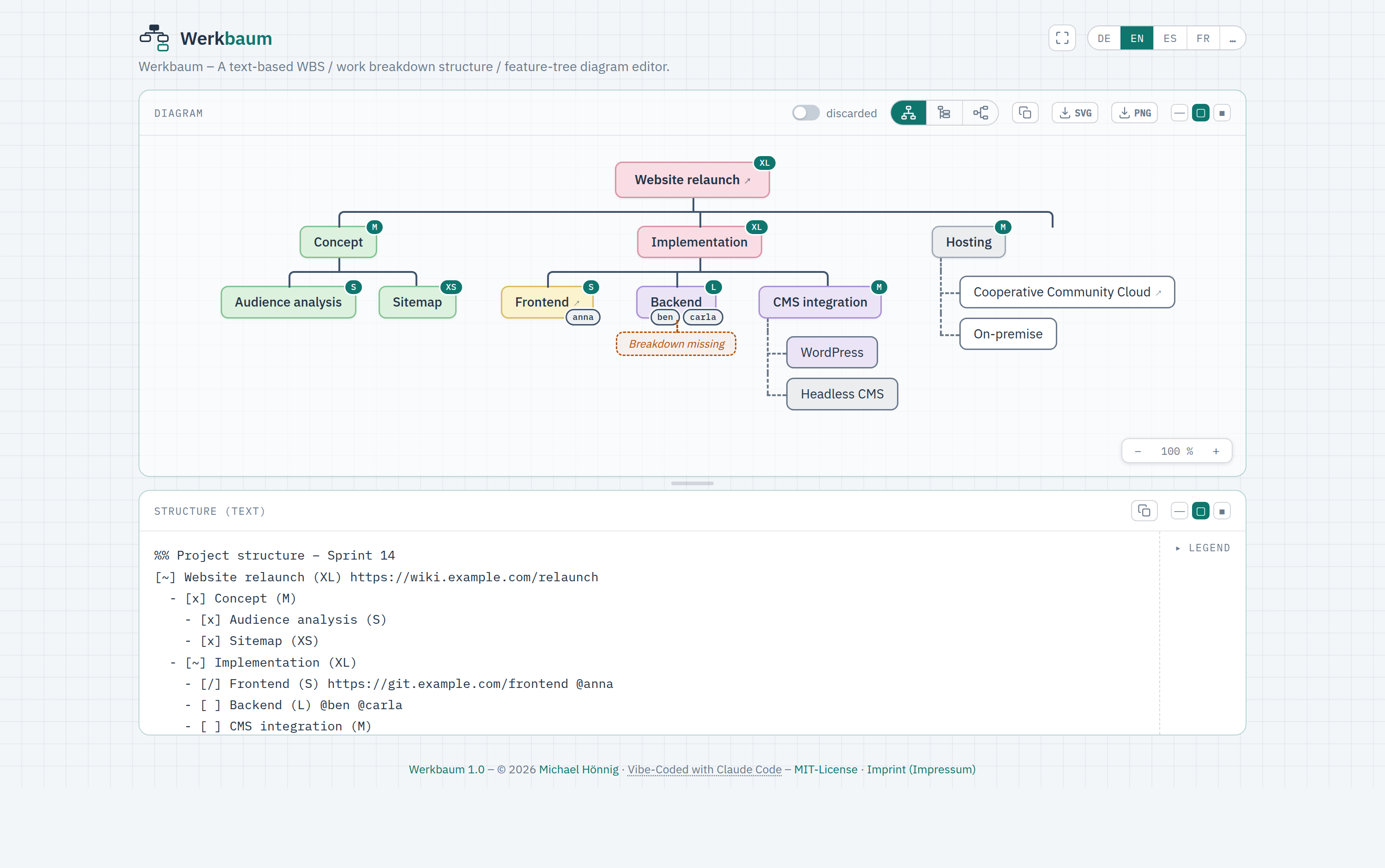
Open the [hosted editor](https://werkbaum.javagil.de) — edit text on
the left, the diagram is built live on the right. Toggles: transposed (narrow)
layout, show discarded elements.
### Jumping between diagram and text
Diagram and editor are linked in both directions:
- **Alt+click a node** (keyboard: **Alt+Enter**, touch: **long press**) selects
its line in the text editor — collapsed editor panel opens first.
- **Moving the cursor in the text** highlights the matching node in the diagram.
A plain click keeps its old meaning: a node carrying a URL still opens it.
### Loading a diagram from a URL
The editor can pull its notation text from an external text file via the
`sourceUrl` query parameter — handy for sharing a plan or keeping the source in
Git or a wiki:
```
https://werkbaum.javagil.de/?sourceUrl=https://raw.githubusercontent.com/mhoennig/werkbaum/main/docs/examples/example-plan-0.werkbaum
```
Ready-made examples in [`docs/examples/`](docs/examples/) — **open them one
after another**, each becomes its own document, so afterwards you can switch
between all of them in the editor title bar:
| Example | Shows |
|---|---|
| **▶ [0 · Online shop relaunch](https://werkbaum.javagil.de/?sourceUrl=https://raw.githubusercontent.com/mhoennig/werkbaum/main/docs/examples/example-plan-0.werkbaum)** | a software project with all eight states |
| **▶ [1 · New kitchen](https://werkbaum.javagil.de/?sourceUrl=https://raw.githubusercontent.com/mhoennig/werkbaum/main/docs/examples/example-plan-1.werkbaum)** | a non-software plan, lots of alternatives — good for the cheapest-path toggle |
| **▶ [2 · Community conference](https://werkbaum.javagil.de/?sourceUrl=https://raw.githubusercontent.com/mhoennig/werkbaum/main/docs/examples/example-plan-2.werkbaum)** | a wide plan with many people; compare horizontal vs. compact |
| **▶ [3 · Three workstreams](https://werkbaum.javagil.de/?sourceUrl=https://raw.githubusercontent.com/mhoennig/werkbaum/main/docs/examples/example-plan-3.werkbaum)** | several roots = several trees side by side |
| **▶ [Werkbaum itself](https://werkbaum.javagil.de/?sourceUrl=https://raw.githubusercontent.com/mhoennig/werkbaum/main/docs/examples/example-werkbaum.werkbaum)** | what exists today and where it could go |
The loaded text becomes its own document whose **name is the URL**, so your own
documents stay untouched; the same link updates that one document instead of
piling up copies. The URL is the source of truth — it is re-fetched on every
load, so local edits to it do not survive a reload.
Notation files use the extension **`.werkbaum`** (UTF-8; see `docs/SPEC.md` §12
and D24) — a convention, not a contract: `sourceUrl` reads any text file over
http(s) regardless of extension or content type.
**Caveat — CORS:** the browser only fetches a foreign host if it sends
`Access-Control-Allow-Origin`. `raw.githubusercontent.com` and GitLab raw links
do; an arbitrary web server often does not. If loading fails the previous
content stays and a warning explains why. Only `http`/`https` are allowed.
### Working on one plan together (Etherpad)
For real-time collaboration Werkbaum needs no backend of its own — it borrows an
**Etherpad**. Pass the pad address as it appears in your browser (no export path,
Werkbaum appends that itself):
```
https://werkbaum.javagil.de/?etherpad=https://pad.hostsharing.net/p/my-plan
```
Everyone edits the notation text **in the pad**; a reload button next to the pad
button fetches the current state. Merging simultaneous edits is Etherpad's job —
that is the whole point.
Deliberately **no background polling**: Etherpad rate-limits the export (10
fetches per 90 s per IP by default), so a timer does not win against it — it
*causes* the throttling. Measured: after exceeding the budget the server holds
the connection open with no reply for about two minutes, then answers in 0.4 s.
The button pairs well with "what's new": press it, and whatever went into
production since your last look lights up.
Because the pad is the writing surface, the text area here is **read-only**; a
button in the editor title bar opens the pad in a new tab. Without that
protection, anything you typed would vanish on the next fetch.
Verified against Etherpad: the plain-text export sends
`Access-Control-Allow-Origin: *`, and the notation comes back **byte-identical** —
leading spaces, `-`/`+`/`|`, status boxes and `%%` survive Etherpad's storage
model, and `-` is not turned into a bullet list.
The pad can also be **embedded** in the editor panel: a selector in the title bar
cycles through *pad and text* (split by a draggable divider), *pad only* and *text
only*. The narrow text mirror keeps its purpose — the jump between diagram and
text works on it, and in *pad only* a jump brings it back by itself. The frame is
only loaded while it is visible, because a loaded pad connects and shows you in
the pad's list of people.
**A shared pointer:** write `!!!` on a line and that node is highlighted and
scrolled into view — for **everyone** looking at the pad, which is something a
cursor cannot do. Recognised only as a standalone token, so `Careful!!!` stays an
ordinary label. It stays in the text until someone deletes it.
**Be aware:** your plan text then lives on third-party infrastructure, and a pad
is readable by anyone who knows its address. In an embedded frame Etherpad's
author cookie (`SameSite=Lax`) is not sent, so you count as a new author on every
load — fixable only on the server (`cookie.sameSite: "None"`).
For the same reason the **embedded frame is best for reading along**: if editing
in it ever stops working, cycle the view selector once (that reloads the frame),
or use the "edit in the pad" button and work in the pad's own tab, where the
cookie does apply. See `docs/DECISIONS.md` D31 and D32.
### Running it locally
The editor source now lives as ES modules under `frontend/src/`, bundled by
[Vite](https://vitejs.dev/) (see `docs/DECISIONS.md` D19). Because browsers block
ES-module imports over `file://`, opening `frontend/index.html` directly no
longer works — use one of:
```bash
cd frontend
npm install # once
npm run dev # dev server at http://localhost:8137
npm test # Vitest unit tests
npm run build # -> frontend/dist/index.html (single self-contained file)
```
The built `dist/index.html` inlines all JS, CSS and the favicon, so **that** file
does open standalone via `file://` and is what gets deployed.
### Build hint & your own production install
Non-production builds carry a small hint next to the title (symbol + tooltip) so
it's clear this is **not** the stable instance:
- **Dev server** (`npm run dev`) → 🔧 "Preview – local development build"
- **Default build** (`npm run build`, incl. the GitHub Pages deploy) → 🚧
"Latest build – may still be buggy"
For **your own production install** the hint is switched off:
```bash
cd frontend
npm ci # or: npm install
npm run build:prod # -> frontend/dist/index.html WITHOUT the hint
```
`build:prod` runs Vite in mode `prod`; `frontend/.env.prod` sets
`VITE_BUILD_BADGE=none`, so the badge code is tree-shaken away entirely (it isn't
even present in the output source). Drop the resulting `dist/index.html` onto your
web space/server (standalone, `file://`-capable). Details: `app.js`
(`mountBuildBadge`), `docs/DECISIONS.md` D16.
Two things otherwise handled only by the Pages workflow, to fix up yourself when
self-hosting: the footer **MIT-License** link is relative to `../LICENSE` (place
that file one level above `index.html`, or adjust the link), and the **version
number** stays the source placeholder `1.0` (the workflow otherwise replaces it
from `VERSION` + commit count).
**Easier: `scripts/deploy-prod.sh`.** The script runs exactly that prod build
**and** both fix-ups (drop `LICENSE` alongside + straighten the link, footer
version + commit link just like the Pages workflow) and mirrors the result to a
server via rsync/SSH:
```bash
scripts/deploy-prod.sh mih00@mih00.hostsharing.net:~/doms/werkbaum.javagil.de/htdocs-ssl
```
The target is either this argument or — with no argument — the `DEPLOY_TARGET`
variable from the **git-ignored** file `.env` (template:
`.env.example`, copy it once and fill in the path). An argument
takes precedence.
Without `-y` it first shows a `--dry-run` preview and asks for confirmation.
`rsync --delete` ensures **nothing old** is left at the target — so the target
directory is treated as exclusive to Werkbaum (an in-flight Let's Encrypt
challenge under `.well-known/` is spared via `--filter=protect`, and web-friendly
755/644 permissions are enforced). (Hostsharing: a **directly-served** domain is
served from `…/htdocs-ssl/`; as a **subdomain** under another domain the web
directory would be `…/subs-ssl//`.)
## Project documents
- `frontend/` — editor · `backend/` — Kotlin/Spring (scaffold to follow, see backend/README.md)
- `docs/SPEC.md` — normative language definition
- `docs/DECISIONS.md` — design decisions with rationale
- `docs/ROADMAP.md` — Mermaid plugin, Taiga integration, Tenzu
- `docs/TASKS.md` — open tasks (checkboxes)
- `docs/brand/BRAND.md` — logo, wordmark, usage rules
- `docs/design/` — design derivation of the brand
- `CLAUDE.md` — project context for Claude Code
> **Note:** The detailed project documentation under `docs/` is maintained in
> German, the project's source language (see `CLAUDE.md`). This README is
> available in [English](README.md) and [German](README.de.md).
## Deployment
The editor is published as a static page on **GitHub Pages** via GitHub
Actions (workflow: `.github/workflows/pages.yml`). Triggered on every push to
`main` and manually (`workflow_dispatch`).
The workflow sets up Node, runs `npm ci`, `npm test` (Vitest) and `npm run build`
(Vite), then publishes the bundled `frontend/dist/index.html` as `index.html` at
the root URL, plus `LICENSE` for the MIT link in the footer. The favicon is
already inlined into the build, so nothing else needs copying; only the runtime
`../LICENSE` link is straightened on the copy. A failing test blocks the deploy.
`backend/` and the remaining `docs/` are not published.
While assembling the site, the workflow also stamps the version into the footer:
**major.minor** comes from the `VERSION` file (bumped by an explicit "bump
commit"), and the **micro** part is the number of commits since that last bump —
so it grows with every commit and resets to `0` right after a bump
(`Werkbaum 1.0.0`, `1.0.1`, … then bump `VERSION` to `1.1` → `1.1.0`). Nothing is
written back to the repo. In the footer the name **Werkbaum** links to the
repository, while the **version number** links to that exact commit
(`…/commit/`). Opened locally, the editor shows the source placeholder
(`Werkbaum 1.0`).
**One-time setup:** In the repo settings under **Pages**, select **Source** =
"GitHub Actions". The repo must be **public** for this (GitHub Pages via Actions
is only available for private repos on a paid plan).
### One command for the server: `remote`
Everything that happens on the server is reachable as **target and action**:
```bash
remote backend deploy # build, upload, unit, restart, then probe
remote backend log # follow backend.log
remote backend status # systemctl --user status
remote backend info # which build is running, through the proxy
remote backend backup # stop, fetch the database, start again
remote backend reset-password # asks, hashes it on the server, verifies
remote frontend deploy # promote, build, assemble, mirror
remote frontend preview # what would change — writes nothing
remote frontend info # which version is out there
remote ssh # a shell on the server
```
`remote --help` lists them all. With [direnv](https://direnv.net) the repo's
`.envrc` puts `tools/` on `PATH` (once per checkout: `direnv allow`), so the
command needs no path; otherwise call `tools/remote`.
The scripts under `scripts/` remain the implementation and stay usable on their
own — `remote` is the front door and brings along only what had no script
before: the systemd verbs, the log, the state queries and the backup.
### Stable instance
`scripts/deploy-prod.sh` mirrors a badge-free production build to a server over
SSH (target in `.env`, template `.env.example`). Unlike Pages this is a
**deliberate** step, so it is also the moment a feature actually goes live.
The script therefore starts by running `scripts/promote-shipped.sh`, which turns
`[x]` (done) into `[^]` (in production) in `docs/examples/werkbaum.werkbaum`
— the shipped plan describing Werkbaum itself — and records that as its own
commit. The convention is: mark a finished feature `[x]` when it is merged and
let the deploy promote it. That keeps the plan honest on both instances and
keeps the "what's new" highlighting meaningful. Skip it with `--no-promote`; see
[docs/DECISIONS.md](docs/DECISIONS.md) D30.
The commit is **not** pushed automatically — run `git push` afterwards, or the
footer version link points at a commit GitHub does not know yet.
### Backend on the stable instance
The backend is a separate deploy, because it is a service rather than files:
```bash
remote backend install-jdk # once: a JDK 21 into the server's home
remote backend deploy # build, upload, systemd user unit, restart
remote backend reset-password # asks for the master password, hashes it there
remote frontend deploy # the editor — also writes the /api/ proxy rule
```
(The same four as `scripts/install-jdk.sh`, `scripts/deploy-backend.sh`,
`scripts/reset-password.sh` and `scripts/deploy-prod.sh`, if you'd rather call
them directly.)
`GET /api/v1/info` answers with name, version and build time — that is the
liveness check, for the deploy and for monitoring. Expecting a **404** from a
document that does not exist would be a poor assurance: a misconfigured proxy
returns one too.
Configuration lives in the git-ignored `.env` (template `.env.example`):
`BACKEND_SSH`, and optionally `BACKEND_DIR`, `BACKEND_JDK_DIR`, `BACKEND_PORT`,
`BACKEND_XMX`.
- **A JDK of our own**, because the measured target has only Java 17 while the
build asks for 21. `install-jdk.sh` fetches it from Adoptium and **verifies
the checksum from their API before unpacking**.
- **A systemd user unit** (`scripts/werkbaum-backend.service`, a template with
placeholders). It survives the session because `Linger=yes` is set on that
host; paths are written as `%h/…`, since systemd expands no shell variables
there.
- **The service listens on 127.0.0.1 only.** The way in is a
`RewriteRule … [P]` in `.htaccess` — measured to be permitted on this host,
and measured to hold a request open for 30 s, which is what the change feed
needs. `BACKEND_PORT` is the single number Apache and the service must agree
on; both scripts read it from the same place.
- **The master password never leaves the server.** It goes into
`/env` (mode 600), which the deploy creates empty on the first
run. Until a hash is in it, the document list stays locked — deliberately.
`scripts/reset-password.sh` asks for it, sends it to the server over
**stdin** (never as an argument — those show up in the process list) and
verifies afterwards that hash and password match. Never put a password on a
command line: it lands in the shell history, and the shell mangles it on the
way — `ge$heim` becomes `ge`. What gets hashed is then not what you type
later, and the server answers 401 while everything looks right.
- **Memory is the scarce resource on that host**, not CPU. The JVM flags are
measured, not guessed: `-Xmx192m -Xms48m` plus heap free ratios lands at
~174 MB RSS, where the defaults take 291 MB. See
[docs/DECISIONS.md](docs/DECISIONS.md) D77 for the table.
## License
MIT — see [LICENSE](LICENSE). © 2026 Michael Hönnig. The bundled IBM Plex fonts
are under the SIL Open Font License 1.1 (see [LICENSE](LICENSE) and
`frontend/src/fonts/OFL.txt`).